East Germany, 1949 to 1990
What was the GDR? A guide for visitors
East Germany from 7 October 1949 to 3 October 1990 with exact dates, and how the DDR Museum's flat, Trabant and Stasi rooms fit the story.
Check dates and availability ↗Quick answer
The GDR, or DDR in German, was East Germany: a one-party state led by the SED that existed from 7 October 1949 to 3 October 1990, with East Berlin as its capital. Construction of its Berlin Wall began on 13 August 1961, and the border opened on 9 November 1989. The DDR Museum shows what daily life under it was like, from a furnished tower-block flat and a Trabant simulator to surveillance rooms, and lets you touch most of it.
Two states, 1949
After 1945 Germany was occupied by four Allied powers. The American, British and French zones formed the Federal Republic of Germany, or West Germany, on 23 May 1949. The Soviet zone followed on 7 October 1949, when the German Democratic Republic was established under the Socialist Unity Party, the SED. On that day the Soviet military government handed legal power to East German bodies. East Berlin became the capital. GDR is the English abbreviation and DDR the German one, which is why the museum uses DDR in its name.
A one-party state
The SED ran the country. Wilhelm Pieck was president, but SED general secretary Walter Ulbricht held most executive power. In 1971 Ulbricht was removed after Soviet leader Leonid Brezhnev supported his ousting, and Erich Honecker replaced him. Honecker led until 18 October 1989, when he resigned and Egon Krenz took over. The museum reflects this structure: part of the exhibition is laid out as a semicircle of power with the party at its centre, and you open doors, hatches and drawers to see behind the facade.
13 August 1961: the Wall
Before the Wall, about 3.5 million East Germans, around 20 per cent of the population, left the GDR, many through Berlin. On 15 June 1961 Ulbricht told a press conference that no one intended to build a wall. Construction began on 13 August 1961, and the authorities called it the Anti-Fascist Protection Rampart. Afterwards more than 100,000 people tried to escape and over 5,000 got across. Estimates of the number killed by East German authorities in and around Berlin range from 136 to more than 200. The Wall stood for just over 28 years.
Read next: The DDR Museum and Berlin's Cold War Sites
Daily life: the flat and the Trabant
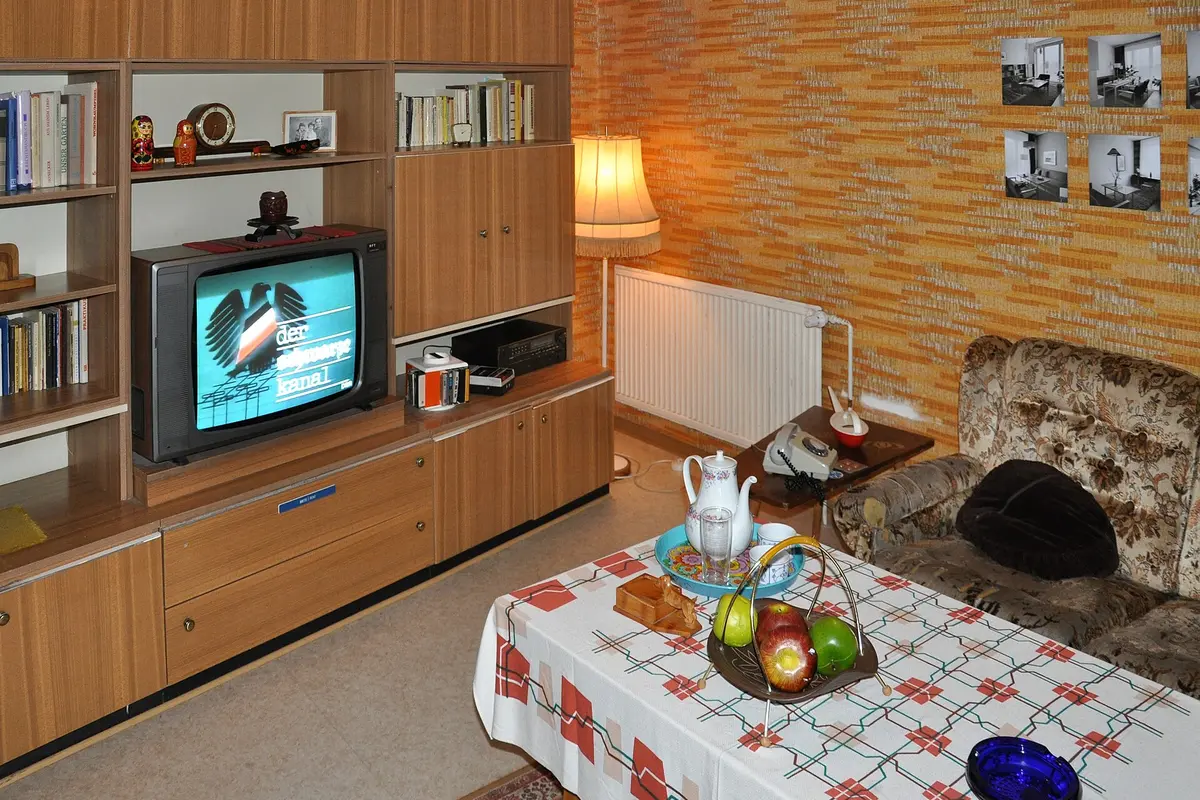
Two exhibits stand for everyday life. The flat is a reconstructed tower-block apartment with hundreds of original objects, built as a WBS 70, one of the standard prefabricated series. The Trabant is the other. The first one left the Zwickau factory on 7 November 1957, the P601 was made from 1964 to 1990, and 3.7 million Trabants were built in all. It had a two-stroke engine, and buyers joined a waiting list that could last years. At the museum you sit in an original P601 and take a simulated drive through prefabricated housing districts. Smaller things can be handled too: in the flat you can try on GDR-era clothes, change the television channel or use an original typewriter.
Watching and being watched
The Ministry for State Security, the Stasi, was founded on 8 February 1950. In 1989 it employed 91,015 people full-time and had 173,081 informants. At the museum a covert listening device gives you the sense of being under surveillance, and the exhibition includes a surveillance room, an interrogation room and a prison cell. For more detail, the Stasi Museum is in House 1 of the former ministry. Built in 1960 and 1961 as the residence of Erich Mielke, minister from 1957 to November 1989, it keeps his office rooms in their original condition.
Read next: The Stasi and Surveillance at the DDR Museum
Autumn 1989
On 19 August 1989 a border gate between Austria and Hungary opened at the Pan-European Picnic, and more East Germans tried to flee via Hungary. Monday demonstrations began in Leipzig on 4 September 1989. On 9 October the state had police and army units ready, but the march went ahead peacefully, and its best-known chant was "Wir sind das Volk" (we are the people). Honecker resigned on 18 October. On 9 November 1989 crowds gathered at the Berlin checkpoints and, with no one willing to take responsibility for using force, the border guards opened the gates.
1990: from free election to unity
The GDR held its first free elections on 18 March 1990. The treaty on monetary, economic and social union was signed on 18 May and came into force on 1 July 1990, when the Deutsche Mark replaced the East German mark. The Unification Treaty was signed on 31 August 1990, and the settlement with the four Allied powers on 12 September 1990. On 3 October 1990 the GDR ceased to exist and its territory joined the Federal Republic as five new states. Germany marks 3 October as its national holiday, German Unity Day.
How the museum fits
The museum opened on 15 July 2006 as a private museum. It was nominated for the European Museum of the Year Award in 2008 and 2012. Its own description of the exhibition is everyday life, the Wall and the Stasi, with most objects meant to be handled. It does not follow the timeline above. You move between topics, so knowing the dates first helps you place what you open: a wall unit, a television set, a cinema seat or an interrogation room.
Language, children and access
The exhibition texts and diagrams are in German and English. There is no audio guide, but a printed guidebook is sold at the ticket desk in six languages. The museum says it suits children: objects may be touched, and the flat has a children's room with original toys, plus a kindergarten area. Children under 6 enter free. Pushchairs fit but can be uncomfortable when it is crowded, and the baby changing room key is at the desk. The museum is barrier-free from the entrance, but the promenade can be reached only by stairs or a very steep ramp. Fewer people come after 18:00, and school holidays are busiest.
Who this isn't for
If you want the Wall itself, this is the wrong building: the Berlin Wall Memorial on Bernauer Straße is the place, and its site notes that the Wall there was part of a 155-kilometre border around West Berlin. If you want the secret police in depth, go to the Stasi Museum. If you want a quiet, read-everything museum, expect school groups in term time and a room where people are opening drawers around you. And if you want an audio guide, there isn't one. If you are short of time, the history above is enough background for a visit of around an hour and a half, the average the museum reports.
Frequently asked questions
When did East Germany exist?
From 7 October 1949 to 3 October 1990. West Germany was founded earlier, on 23 May 1949. The GDR ceased to exist on 3 October 1990, when its territory joined the Federal Republic.
When was the Berlin Wall built and opened?
Construction began on 13 August 1961. The border opened on the night of 9 November 1989, after weeks of demonstrations, and the GDR itself ended on 3 October 1990.
Is the DDR Museum the same as the Stasi Museum?
No. The DDR Museum covers everyday life, the Wall and the Stasi, beside the Spree opposite Berlin Cathedral. The Stasi Museum is in House 1 of the former ministry, where Erich Mielke's office rooms are preserved. You can reach it by U-Bahn from Alexanderplatz to Magdalenenstraße station.
Are the DDR Museum's texts in English?
Yes. All texts and diagrams are in German and English. There is no audio guide, but a printed guidebook is sold at the ticket desk in German, English, French, Spanish, Italian and Chinese.
Is the DDR Museum suitable for children?
The museum says yes: objects may be touched, and the flat has a children's room with original toys and a kindergarten area. Children under 6 enter free, and the reduced rate applies from age 6.
How long should I allow at the DDR Museum?
The museum's visitor survey gives about an hour and a half on average. Some visitors stay four hours. You may stay as long as you like.
Sources